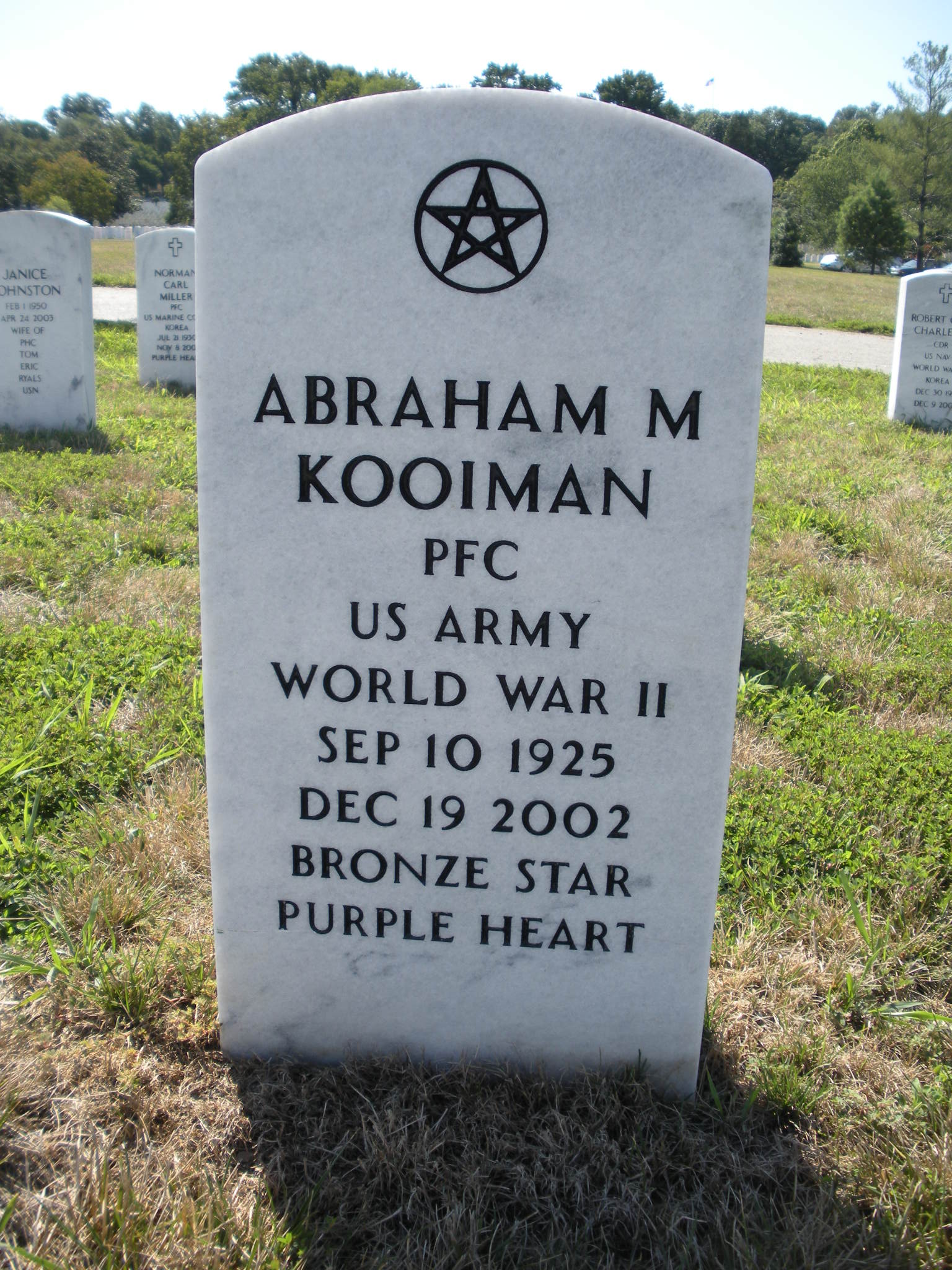
Wicca is one of the religions officially recognized by the U.S. military. This soldier chose to have the Wiccan Pentagram as the religious symbol on his gravestone. Photograph by John C. Hamer, licensed under Creative Commons 2.0 Share and Share Alike.
It recently came to my attention that there are massive, widespread, and persistent misconceptions about Wicca in America.
The reasons for these misconceptions could be elaborated upon in books; but the bottom line is, what is important is what Wicca is.
It is not, as so many Americans seem to believe, devil worship. This misunderstanding probable comes from the old Christian habit of referring to any spirit or deity not explicitly described in Christian theology as a “demon.”
By this logic, virtually all native religions that weren’t Christianity were described as “demonism,” and some Christian pastors still describe all non-Christian practices that way today. Some have even speculated that the Medieval depiction of the Devil as being a horned, goat-like creature was actually based upon the appearance of the “horned god” who appeared in many pre-Christian European religions, in an attempt to convince followers of those religions that their deity was evil.
The fact that many Wiccans today do worship the horned god contributes to confusing Wicca with Satanism – even though the horned god is much older than Christianity and was traditionally a good figure, a bringer of wisdom and prosperity who represented the male horned animals of the European forests and the masculine characteristics of humans.
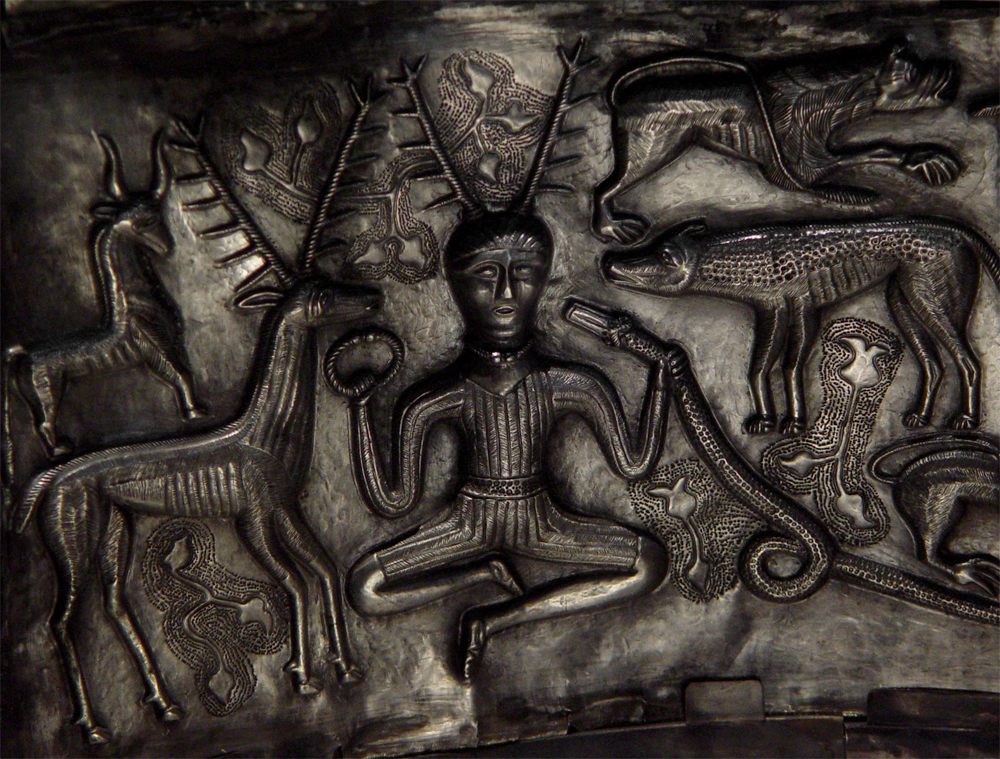
This cauldron created between 200BC and 300AD shows Cernunnos, one of several horned gods found in pre-Christian European mythology. This image is used as a source for many Wiccans who seek to return to pre-Christian ideas about masculinity and man’s relationship with nature. Photograph by Bloodofox, licensed under Creative Commons 3.0 Share and Share Alike.
The formulations of Wicca are even more wide and varied than those of Christianity; just like some Christians believe in the Holy Trinity and others see that as a “pagan” corruption, some Wiccans believe in one God who expresses him/herself through many face seen in pantheons around the world; others believe in more than one absolute God or Goddess, but either way, the moral implications are the same.
Teaching that all Gods and Goddesses are expressions of the same divinity has one obvious implication; that any or all divinities can be properly worshipped as a means of worshipping the ultimate reality.
By that logic, I suppose it is possible that someone could be a Wiccan and worship Satan or another demon as your patron; but by the same token, there is also a large movement called Christian Wicca, which use Wiccan practices to interface with Christ.
So what is Wicca, and where does it come from?
As with most religions, that depends on who you ask. It was introduced to modern audiences in its modern form by Gerald Gardner in the early 20th century; he claimed that he had simply reconstructed the ancient pre-Christian religions of Europe based on old documents and hands-on teachings from European traditionalists, but that is disputed.
However accurate Wicca is to pre-Christian European religious traditions, it certainly succeeds in being a nature-based religion which ties the practicioner to the cycles of nature which would have been important to pre-technological farmers and hunter-gatherers.
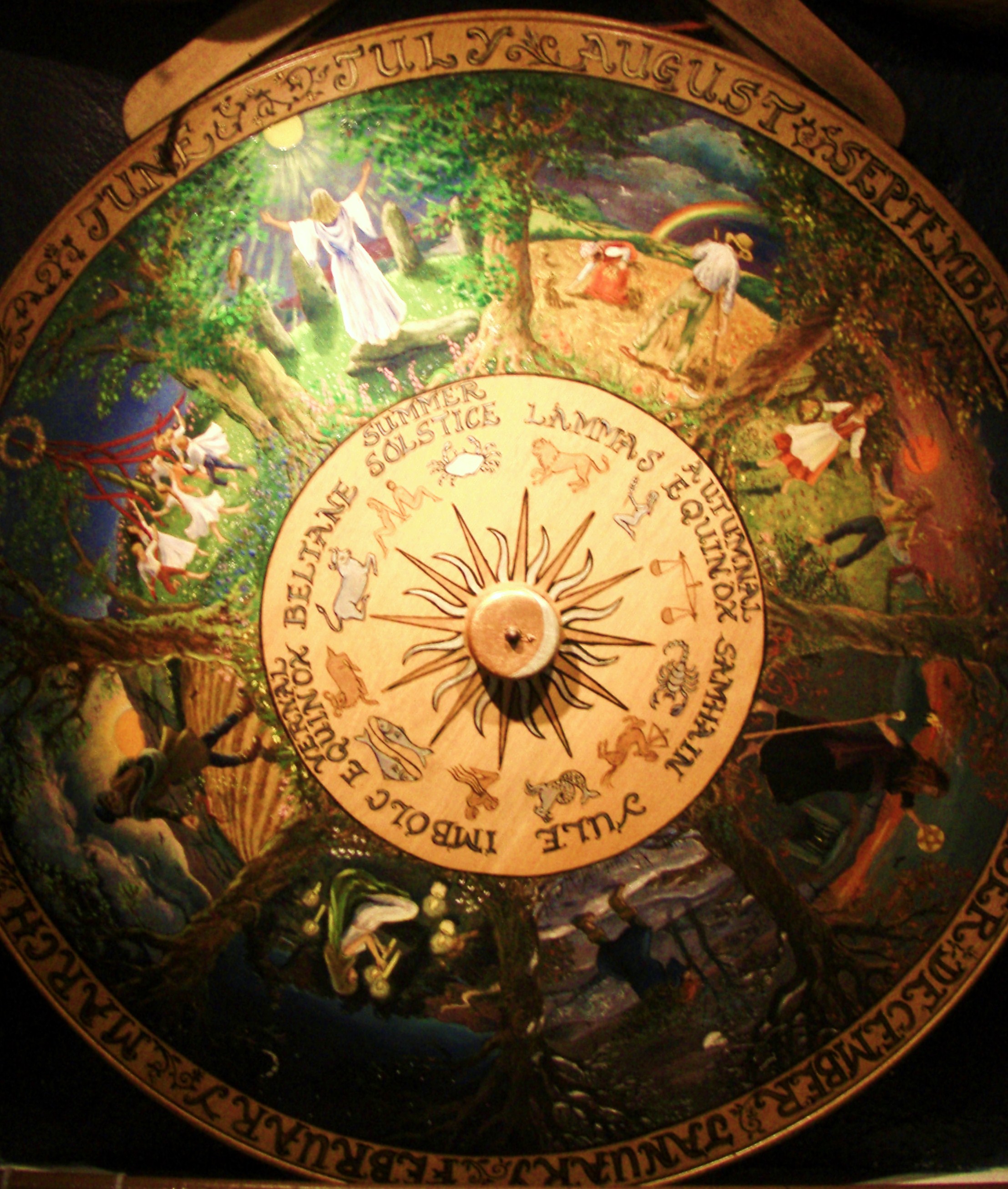
This Wiccan “wheel o the year” illustrates the major festivals as natural scenes, depicting what is happening at the natural world and what a Wiccan celebrant would do at those times. Photograph by Midnightblueowl, licensed under Creative Commons 3.0 Share and Share Alike.
Wicca’s holidays follow the movements of the Moon and Sun, with each holiday’s traditions corresponding to what the natural environment would be doing at that time. Lughnasa, for example, a holiday which occurred just a few days ago, encourages Wiccans to make dishes using crops which would be ripening in early August, such as bilberries and blackberries.
The Wiccan theological framework also relies heavily on the natural world. Just as Taoism speaks of the “yin” and “yang,” which between them describe all the opposing forces in nature, such as masculine and feminine, light and dark, cold and hot, etc., Wicca uses the four elements of Earth, Water, Air, and Fire to encompass all traits of both humans and the natural world.
This is, in fact, the meaning of the five-pointed star called the pentagram; four points of the star represent Earth, Water, Air, and Fire, while the fifth represents the element of the human mind and spirit. The middle of the star, where all five points overlap, represents the world, which is ruled by both the physical elements and the mind/spirit.
Other popular Wiccan symbols include variants on the full and crescent moons, as the waxing and waning of the moon is a natural way of measuring time, and is seen to symbolize the waxing and waning phases of human life as well.
In Wiccan ritual magic, a practicioner symbolically communicates with and manipulates these elements in order to bring about changes in themselves and their environment.
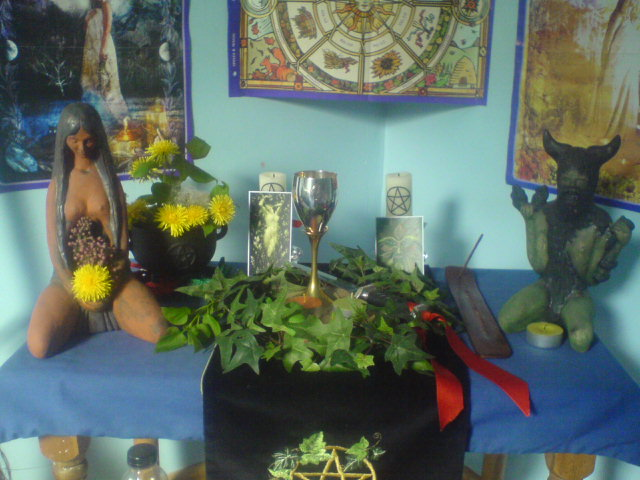
One Wiccan’s altar for the celebration of Beltane. Traditional Wiccan altars include a chalice, which represents feminine energy, and a blade, which represents masculine energy. Note the representations of goddess and horned god, the wheel of the year, and the pentagrams. Photograph by xxGlenxx, licensed under Creative Commons 3.0 Share and Share Alike.
So is it possible that a Wiccan may have felt that murder was an appropriate ingredient in one of their rituals? It’s certainly possible, in the same way that Jim Jones and and David Koresh felt that mass murder-suicide was a proper expression of Christianity. But such a Wiccan would be in a great deal of trouble with Wiccans who believe in the “three-fold law” which states that any harm or good you do to others will be revisited upon you, multiplied by three.
In addition to all of this, the most popular moral “rede” for Wiccans goes like this:
“An ye harm none, do what thou wilt.”
Not all Wiccans follow the rede, in the same way that not all Christians follow the Nicene creed. But clearly this religion, in its primal form, does not encourage murder!





 Good evening, everyone,
 religions that continued to dwell around them. Indeed, an essential role of certain classes of Buddhist and Taoist priests is to perform rituals to communicate with place spirits, minor deities, and other things.